A huge Chinese manufacturing company called Haier has sponsored us to make an 8 part documentary series called "Higher and Higher: From Qingdao to Mt. Everest Base Camp." We'll start from Qingdao and film about the city and the coming Olympic events there. Then we'll do the same in Beijing. From Beijing, we ride the new Sky Train to Llasa, Tibet. From Lhasa we ride mountain bikes on the Friendship Highway to Mt. Everest Base Camp. After that, we descend the longest downhill in the world to Katmandu, Nepal.
However, for this journey we'll be posting on our new blog, not this one. Go to www.haierbrothers.blogspot.com. I'll add stuff here on occasion, but honestly the new blog will be awesome. FYI, while we are still Brusie and Seabass, we also are now The Haier Brothers.
Come see us at:
www.haierbrothers.blogspot.com
Wednesday, June 27, 2007


Tuesday, June 26, 2007
The Best of the Dammed Yangtze
The Three Gorges Dam on the Yangtze River, now complete, is transforming the face of South Central China. Cities like Chongqing are ballooning into major metropolises comparable to a Cleveland or Chicago. Other cities have climbed the river banks to avoid drowning beneath to the rising Yangtze. The landscape and people here face incredible change at a rate no other society has ever experienced before. This movie shows what the journey down the river is like, as well as gives you a taste of what the landscape and people along the Yangtze are now becoming...
Wednesday, May 23, 2007
Chengdon't...no such thing
If we dared argue Chengdu, Sichuan Province, was no match for the likes of us, we'd be fooling ourselves or lying to you. What with vanishing pandas, Godzilla-sized Buddha's, conniving monks and a full-bore nightlife, it definitely was a city to be reckoned with. Still, even though this contest went into extra rounds, we came out hungover. Take that Chengdu.
Expect a full article about the Yangtze very soon. And expect us to try out our new catchphrase: "Let's get awkward!"
Expect a full article about the Yangtze very soon. And expect us to try out our new catchphrase: "Let's get awkward!"
Tuesday, April 24, 2007
Tigers, drinking, skiing and North Korea
The complete series is finished! In this blog entry we have placed the whole series, beginning with our first escapade through Haerbin. The second movie includes skiing in Yabuli. The last and final segment to our slavepiece is our adventure along North Korea. Also, please check out the article that follows the third segment. It details our experiences along the North Korean frontier.
Enjoy and leave comments and feedback. Although we're in a nation of 1.3 billion people, we get lonely.
Part I
Part II
Part III
Epilogue
Enjoy and leave comments and feedback. Although we're in a nation of 1.3 billion people, we get lonely.
Part I
Part II
Part III
Epilogue
Monday, April 23, 2007
In the distance, North Korea

Our first look: Tumen
The Tumen River was frozen all the way across which meant Seabass and I could walk straight into North Korea. Unlike the impenetrable Korean Demilitarized Zone, where hundreds of thousands of South Korean and U.S. troops face hundreds of thousands of North Korean troops in a half-century stare down, the North Korean border with China is porous.
Our pipe dream was to cross the river and take a tour of a ghost town called Namyang, North Korea. But we didn’t have legal permission, and, being U.S. citizens, we weren’t going to get permission either, at least not from Tumen, China, a city on the eastern end of the approximately 900-mile long border. Unless we wanted to risk our freedom, or who knows what else, we could only spy North Korea from a distance.
Admittedly, North Korea struck fear in us. It was this fear that made us so eager to visit the nation. We wanted to confirm for ourselves all the negative press that surrounds the most isolated country in the world. We wanted to know about a place where information is so controlled, according to reports we’ve read, the North Koreans think everywhere else in the world is far worse off than they are. A place where people are supposedly unaware man landed on the moon. A place where, if someone tries to escape, up to three generations of the person’s family could land in prison.
We also wanted to confirm something else. We wanted to prove our belief that concealed behind all the negative press about the government and its brainwashed society, the nation, like any nation, consists of good people living as normally as possible under their circumstances. That when greeted face to face on a mutual level, the propaganda engrained in our minds as well as in theirs would wither away and become meaningless.
These thoughts in mind, we paced up and down the boardwalk and scoped what seemed to be a deserted city. We felt caged even though we had the world at our backs while the North Koreans had at theirs only, well, North Korea.

It was a frigid day on both sides of the border. Yet, hardly any smoke rose from the smokestacks in Namyang. On the Chinese side, the locals’ coal stoves polluted the air generously. After an hour, finally we saw movement in Korea. A man dressed in a black coat ran out of a gray building and down an empty street. This mundane incident was fascinating only because he was the first sighting of life; that is, until two brown clad soldiers appeared amongst the high winter grass along the North Korean riverbank, rifles over their shoulders.

Later, Seabass and I watched a group of men cross the bridge between Tumen and Namyang. This may sound strange to many, but I assure you we were jealous. Like I said, we felt caged. We wanted to know about the lives there in the distance. We wanted to know what those men saw and who they had talked to.
But, we could only venture across the river vicariously through a Chaoxianzu (Chinese Korean) woman. She sold North Korean money and rented binoculars and telescopes to tourists.
I asked her if we could cross to North Korea and she laughed the proposal away. I asked her if she had crossed.
“Once a year,” she said as she stared across the frontier. “I bring them food and clothes because they don’t have anything over there.”

She invited us to peek through her binoculars. Across the bridge stood a large billboard of Kim Jung-il’s father, Kim-Il-sung, to welcome any one privileged enough to visit the third world ‘rouge’ nation. The woman then encouraged us to step off the boardwalk and onto the black mud and brown grass that led to the river. We were unsure, but she said it was fine if we walked out to the riverbank for a closer look.
We stepped lightly through the marsh and reached the rocky edge of the Tumen River. Hands on our sides, we shook our heads and pondered — the river was solid ice and we could easily walk to the other side. There was no need for the bridge during the winter. We were equivalent to standing on the fifty-yard line with no defensive line between us and a touchdown. The guards were gone. They had marched farther up the river and out of sight. However, our better judgment prevented us from crossing the line of scrimmage.

In one last symbolic gesture before we left Tumen, we picked up stones from the Chinese riverbank and flung two Hail Marys across to North Korea. We figured those rocks were the closest we would ever get to the mysterious nation, but we also intended to keep poking around.
Changbaishan
The next opportunity was further west along the border at the Changbaishan Nature Reserve. There rises Changbai Mountain which holds Heaven Lake in its crater. The spectacular crater alone takes one’s breath away. But the fact that it is split in two, one part in China, the other in North Korea makes the park extraordinary.
Moreover, I had also read a story about a British man who skied the crater and accidentally crossed the border into North Korea. I’ve never confirmed this tale, but it was said that the DPRK held the man for a month before they released him. Knowledge of this added fuel to our imagination.

Though not a designated ski area, we brought our skis along for our attempt to skirt the icy North Korean border. We assumed we could hike the mountain until we learned walking up there on our own in the dead of winter was discouraged. Now that we were at the foot of the mountain looking skyward to the peaks, we had to admit we underestimated it.
The simplest option to get up to the crater was if we paid $25 dollars a piece and rode up in a Sno-Cat. A friend, we met him and his sister in the nearby town of Baihe, explained that the catch was we could only stay at the peak for 30 minutes, then everybody, no exceptions, had to ride down in the Sno-Cat. The drivers offered to take us part way up the mountain if we wanted to ski, but skiing from the top was ‘bu keyi’ or ‘not okay.’
Seabass and I toiled over the prices. For China, it was expensive. Also, after the purchase we wouldn’t have any money unless we got back to the hotel which was an hour away. We looked at each other straight in the eyes and came to a nonverbal agreement. Again, the Sno-Cat drivers offered us a ride halfway.
We declined and said we wanted to go the distance.
“Fine,” said one of the drivers, a husky man built of principle and rules. Then he explained the rule that most applied to us, “You can’t bring your skis.” Another Changbaishan employee, a young guy who was eager to befriend us, explained in broken English what we already just understood in Chinese. Then the brother and sister we met in Baihe also reiterated the point: no skis.

“Our skis are expensive and they stay with us,” Seabass held our ground. “We already bought our tickets. Let’s go. Let’s put the skis in the vehicle.”
The next thing we knew our skis were in the Sno-Cat. The first of our bluffs worked.
On our way up we eyed potential ski runs. The snow coverage was spotty, but much better than anywhere else we had seen in China. It seemed the snowfall accumulation was enough to ski, but we had limited runs due to strong winds that blasted the snow completely off many of the convex slopes above tree line. The snow only stayed in the volcanic runnels that snaked down the mountainside.
After a 30-minute climb we viewed, mouths agape, the massive crater lake and 8,000 foot peaks around it.

The weather was phenomenal except for the strong gusts. Seabass and I gave each other high-fives and acted like giddy fools. North Korea was just there in the distance and many of the peaks offered excellent ski runs. One thing we had to decide was how to enter the crater, as the side we were on consisted mostly of cliffs. To get a better look, we toe-kicked up to a peak farther away from the other tourists. This displeased the Sno-Cat drivers. We could hear them yelling for us to return. Strategically, we ignored them.

On our way back all of the Chinese were in the Sno-Cat and the husky driver looked upset. Our friend ran out and said it was time to go, the half-hour was up.
“We’ll stay here,” Seabass and I both said.
“You can’t.”
“Why?” I asked.
“You can’t. It’s not okay.”
“No,” I said. “We’ll stay here.” Seabass and I would be damned if we were going to travel all this way, actually find snow coverage in China on challenging slopes, and then ride down in a Sno-Cat. Especially, since we were potentially on the brink of infiltrating North Korea.
Our friend passed the refusal on to the driver as we stood defiantly on the plowed road. We made sure to stay far away from our ski gear though, as we didn’t want that to enter into the dispute.
The big driver stepped out of the Sno-Cat, walked toward us and told us to get in. We shook our heads trying to act cool. Finally, he relented. He threw his arms up knowing this was against principle, against the rules. Perhaps we were in the wrong from a cultural standpoint. After all, we were in China, not the other way around. But, there seemed a higher principle to us: we should enjoy a worthwhile amount of time at one of the most beautiful places on earth. From our side of the story, there was no harm in us staying on the peak, nor any harm in us skiing down it. In China, things are often not allowed only because they are unfamiliar. Sure, you can drive on the wrong side of the road against traffic on a major highway, or dump oil and garbage straight into the ocean, but stay on a beautiful peak to enjoy the view more than the allotted 30-minutes, well, according to the Changbaishan organization, that just shouldn’t be done.
The Sno-Cat rounded the bend and down the mountain. We sighed in relief. It would have made us sick if we had to ride down. We had won.
Or so we thought until we heard the grinding tracks one minute later. Now we were putting on our ski gear and the driver was looking straight at us through is impenetrable sunglasses. The gig was up.

Our friend again jumped out of the Sno-Cat and ran toward me. Seabass stayed in the background.
“Bu keyi,” he said.
“Ah, come on!” I yelled, not meaning to direct my frustration at him, but I did.
He tolerated it. “You have to come with us now.”
“No.”
The driver, along with our friend’s sister and several others, now stood around me as if they were talking me down from the windowsill of a skyscraper. I decided to stand firm. I was going to jump.

“I just talked to my bosses at the base and they said I can’t leave you here,” the driver said. He wasn’t intimidating, but he could have been. In fact, he was soothing and really cared.
“No,” I repeated. “We’re not coming with you. We’ll walk down.”
The driver saw our ski gear and shook his head. “You can’t ski down. It’s too dangerous.”
“Dangerous! Dangerous?” I blurted. “We’ll stay on the road. Look, I’m standing here on the road now. Is it dangerous? Look, I’m walking on the road right now,” I executed my words down the road and back. “Is it dangerous? Is it?” I repeated my example, but performed more of a goofy prance this time.
The driver cracked a smile and I knew I had him.
“I promise we’ll stay on the road,” I said, winded after my act. “We’ll walk down on the road.”
“You can ski down on the road,” he suddenly offered.
“No,” I said with a smile. “We’ll walk down.” It was a boldfaced LIE, which is against my principles. But there was no turning back now. Our series of deceptions were going to get us fresh tracks. He probably didn’t believe me anyway.
I hugged everyone involved in the intervention. Basically, we came to an understanding that I was going to jump from a lower floor, and so, from their perspective, at least I had a chance, and that was good enough for them.

The Sno-Cat vanished and I walked toward Seabass, big grins across both our faces. We were almost a hundred percent certain we had won. And what a victory! We had the whole mountain to ourselves. It was immense — even more special knowing Manchurian tigers were in the forest that stretched out across China as far as we could see and North Korea foreboded just beyond the tips of our pointing ski poles.

Then we started to argue. Seabass was unsure if we should try to enter the crater as it looked, of all things, dangerous. We cautiously stepped inside the crater to an outcropping cliff. We agreed it was possible to enter, although it wouldn’t be easy. If we entered the crater, we could ski to the border, take a picture near the approximate area the line would be, as its not marked necessarily, and hike out.
Suddenly, a new problem arose from the North Korean peaks across the lake. Towering thunderclouds splashed against them and spilled over like a storm wave bashing an ocean breakwater. We had read the weather here was fickle and the proof was before our disappointed eyes.
What could we do but wave at North Korea and swear a swift reunion. Although we were bummed, we consoled ourselves with the knowledge we could ski the outside of the crater.
On our way to the snow path that twisted down the mountain, we ran into a Chinese soldier dressed in olive winter garb, a red star on his winter hat. The three of us were the only human presences.
We explained where we were from and he seemed comfortable that we two Americans were on the peak, unlike the Changbaishan employees. We asked him about North Korea but he didn’t seem comfortable to talk about that topic. He saw we had skis and recommended we ski down. He said he thought that was a clever idea. His opinion, we told ourselves, redeemed us from any guilt we should feel for having lied to the others.

We skied a great run. The windblown snow was great to carve and we devoured several thousand vertical feet. We met the road again and saw a Sno-Cat passing with a bundle of Chinese tourists. We tried to thumb a ride but the driver ignored us.
A moment later, we ran into a few Chinese snowboarders. They were locals astute in catching snowmobile rides partway up the mountain. They guided us down a difficult tree glade. One turn would carve on solid snow, the next would break through it up to the knees. However, in the shadows existed pockets of thick powder.

At the bottom of the run, the snowmobiler tried something stupid and got stuck. We pushed him out and he gave us a free ride back up. We skied the glade again, hiked up one more time, then called it a day.
That night we had to catch a train at 4:30 a.m. The skiing was an unforgettable experience, but the nagging fact that we hadn’t reached North Korea left us unfulfilled.
Dandong and The Great Wall
Our best and last hope of actually entering North Korea was at the final stop on our border journey: Dandong, China. The large border city lies on the far western end of the Sino-Korean frontier and serves as the main thoroughfare for trade between the two nations. Yet, only every three to five minutes did we see a truck cross the Sino-Korean Friendship Bridge. The bridge crosses the Yalu River and links Dandong with Sinuiju, North Korea.
During the day, a pleasant boardwalk follows the Yalu River on the Chinese side. Foot and vehicle traffic flows constantly before a backdrop of 10 to 15 story buildings. Meanwhile, on the Korean side, traffic and people are almost nonexistent in front of one to five story buildings.

At night, the difference between the two riverbanks is starker. Dandong glows brightly and the Friendship Bridge is a rainbow of lights halfway across. However, at the point the bridge reaches North Korea’s territory the lights stop due to the country’s energy crisis. It was so dark across the Yalu River it was like looking out to open sea at night.

Next to the Friendship Bridge extends another called the Broken Bridge. The Chinese declare it was the only target bombed by the U.S. on Chinese territory during the Korean War, or what China calls the War to Resist U.S. Aggression and Aid Korea. Seabass and I are unfamiliar with the official position of the U.S. on the bridge bombing, but the Chinese say the U.S. declared it an accident. Obviously, it was not. Also, obviously, the bridge was a main supply line for China to support the war effort, so it made for a logical target. Now, the remains stand as a memorial.

In the afternoon, we bought boat tickets for 10 yuan each and joined a group of Chinese to motor past the Broken Bridge and along the North Korean border. We saw a few fishermen on the riverbank pulling nets from the river. Also, a gentleman and two children stood on a moored boat. One of the children, holding a stick, waved. I waved back.

A few other men and women stood on Sinuiju’s boardwalk and watched emotionlessly as the gaggle of Chinese tourists, Seabass and I used binoculars to ogle at them. Other boats along the river did the same. The experience was comparable to tourists riding in jeeps to see lions on the African Serengeti. I use this comparison to undermine others I’ve read that compare it to a zoo. As dehumanizing as my own image may be, I argue the experience isn’t like a zoo because the North Koreans are in their natural habitat.

“Maybe there is envy,” said Guo Hepeng, a Beijing public affairs specialist for China Customs. We met him on the Broken Bridge. “They see Dandong with big buildings and over there it’s not like that. The Koreans must look at that and it makes them think.”
“We spoke to a woman in Tumen and she said once a year she brings North Koreans clothes and food — is that common?” I asked.
“People aren’t supposed to bring stuff into North Korea,” answered Guo. “It’s very restricted. China’s border rules are tight. It’s hard to bring or receive goods. It’s likely the things were smuggled in. The border is very big.”
Guo explained although China is the DPRK’s closest friend, the nation has isolated itself and alienated others so much that even China wasn’t particularly happy. Seabass and I guessed and Guo confirmed that’s why trade was so minimal across the Friendship Bridge.
From what we could tell from Guo and other Chinese, China waits patiently for North Korea to snap out of its isolation. Everyone we talked to showed confidence in the inevitable change.
“(North Korea) is what China looked like 70 years ago,” said Guo. Memory of China’s own dark age maybe explains why so many Chinese tourists are fascinated by the lonely nation across the river.

While the Chinese are fascinated, Seabass and I became obsessed. North Korea was our white whale. Our dwindling hope lay in the idea we could ask the China International Travel Service to acquire us North Korean tourist visas.
We met Li Ping, an employee at CITS, and he confirmed what all Chinese had been warning us: “Americans can’t go to North Korea.”
“But we know two Americans that went in October,” I said.
“Yes, that’s because North Korea allowed U.S. citizens to travel to North Korea for two months last fall, but now it’s not allowed,” he answered.
Our hearts sank. We were stupid and didn’t do all of the proper research. The one hope he could give us was North Korea may again allow Americans to visit next fall.* If that happened, he said we should contact him and he could definitely help.
Seabass opened his travel book. We had one last, desperate chance at North Korea. This one definitely could get us into trouble.


The book explained North Korea sat just on the other side of Tiger Mountain, a hill along the Yalu River 12 miles outside Dandong. On Tiger Mountain extends the farthest eastern portion of the Great Wall. We paid the $1 it cost to enter the park and walked atop the wall replica rebuilt in 1992, the real structure having disintegrated long ago.

The Great Wall rises almost vertically up the north flank of the hill. Several hundred feet below our noses we saw a thin tentacle of the Yalu River. The stream separated China from Yuchi Island, North Korea. On our side of the waterway, red lanterns swayed outside brick huts in the winter breeze. Across the stream sprawled vacant farmland with thick wheel ruts cutting into the mud. A lone Korean dog lapped the Yalu. Farther in the distance stood a village populated with two farmers working the unreachable soil.
According to other writings about Tiger Mountain, DPRK guards defend the border and will become aggressive if anyone dares set a foot on the land. However, we didn’t see a soldierly soul this day. The tire tracks were from military vehicles that patrolled the border, but we didn’t see any. Perhaps, due to the low tourism season, the guards were pulled from the border. We didn’t waste time in case guards suddenly returned to duty.
We peeled our eyes for the best place to cross the border. We noticed at one point the Yalu tributary was no more than a bold leap to reach the farther bank. It was our last shot.
We descended Tiger Mountain to the stream quickly. Along the way, we picked up a Chinese couple who wanted to follow along. As we neared the wet borderline, a sign in red Chinese characters ordered us not to tread further.

We ignored it.
A Chinese guard appeared from a booth we passed along the road. He had realized where we were heading. “Stop!” he yelled.
We ignored him.
With a leap of determination, we jumped into North Korea and took a deep breath. By the time the guard reached us we were exhaling back in China. We seized North Korean rocks to mark the occasion.
We had made it! We reached North Korea — albeit not under ideal circumstances.
We would have preferred to share a meal and a drink with a few North Korean citizens. Why was lunch with the farmers in the distance too much to ask? Something so simple and good was impossible for too many historical and political reasons.
We began the awful descent down the anticlimax of our adventure. To mark the occasion, we ate some North Korean cuisine along the Yalu River and stared across at the impossible. The dishes, a freshwater fish from the Yalu River and sweet pork ribs, were both mild and tender: delicious. How ironic and sad that our meal couldn’t be shared with the people who had invented it.
China Deep signing off...for now.

* It turns out North Korea is also allowing Americans into Pyongyang, North Korea this spring during the Arirang Mass Games. Americans are only allowed to visit during the games and this year the DPRK decided to hold them twice, once in the spring and once in the fall. However, a tour runs about $2,000 after you pay to come to China. The trip only lasts three days and is very restricted. Our silly version, though obviously not as good, was much cheaper.
Sunday, April 01, 2007
Part II: Skiing, dog eating
Part III coming soon! Imagine two American buffoons tempting fate in North Korea. Again, the last segment of the movie and a detailed story are on the way.
Friday, March 23, 2007
Northeast China--Part I
Finally, the movie is ready. Well, at least we finished the first installment of our three part series. This movie was made as a video documentary, which is different from our other videos. Please give us feedback if you think an article should be included, or does the movie cover everything that needs to be said?
Parts II and III are on the way. They won't disappoint.
Parts II and III are on the way. They won't disappoint.
Sunday, February 11, 2007
Not so China-deep
We could write another long article about Japan, but we won't. This blog being China-Deep, we'll write extensive articles about our upcoming trip to the Northeast of China. Our goal will be to ski at the largest resort in China, see white tigers, go to one of China's most beautiful national parks, and, with luck, stop by North Korea.
Here is a video of our other experiences in Japan that Mr. Seabass put together. The locations include Kyoto, Yokohama and Tokyo. Check out the monkeys, they're amazing.
Here is a video of our other experiences in Japan that Mr. Seabass put together. The locations include Kyoto, Yokohama and Tokyo. Check out the monkeys, they're amazing.
Saturday, January 27, 2007
Nisicko

Seabass and I can’t live without skiing, so we tracked down a Japanese friend of mine, Dice, in Tokyo, and we together made a beeline for Hokkaido. We wasted no time. When we arrived in Tokyo, Dice met us at the station straight after his work. At 8 a.m. the next morning, we were on the flight to the northern island. By 1 p.m., we were on the slopes.

Dice calculated every step of the trip to the second. For him, seconds of vacation count. Dice, like so many other Japanese, is a working stiff — understandably so. He has a house, pregnant wife and 2-year-old daughter to care for. However, the amount he works makes both Seabass and me numb. A typical day for Dice consists of leaving the house at 7 or 7:30 a.m. and then getting home about 10 or 11 p.m. His commute starts with a 10 minute walk to the station, then continues with an hour ride train into Tokyo, and finally ends with another 20 minute train toward his workplace. He toils a chain gang of hours selling bulk widgets, specifically piping valves, and then reverses the commute home. It sapped me to see the tired look on his face after such a long workday.
Without trying to sound self-centered or give myself credit where obviously none is due, I felt good knowing our ski trip would off Dice a break, however brief, from his work life. We had just two and a half days, from 1 p.m. on Friday to 3:45 p.m. on Sunday, to ski before Dice had to return to the grind. By that Sunday afternoon, we had to be on a bus to Sapporo and on a flight home early the next morning.
Dice uses his precious free time wisely, even better than I previously understood. Moreover, his selection of ski venue, Niseko, was perfect. Seabass and I had never heard of the ski town. Now that we know the resort, we prefer to call it Nisicko.
Niseko is a white hole. It sucks all snowstorms in Northeastern Asia to its mountainside. While the rest of Japan wallowed in bare slopes with no sign of any December snow, Niseko had five feet. Locals consider five feet by mid-December a bad start.
Seabass and I looked at the weather forecast for the region, but the weather-folk predicted little new snow. We shrugged off this lame news and felt we were lucky there was any snow at all because of the spare conditions throughout the rest of Japan.
 When we got on the hill that Friday afternoon, a crazy thing happened. We found powder. There was sun, blue sky, a beautiful view of a volcano and…powder. It was only ankle to boot deep, and we had to be somewhat adventurous to find it, but sure enough there was powder.
There is a funny thing about skiing in Japan. Seabass and I had heard rumors, but never quite believed it was true until we saw it ourselves. The Japanese don’t like, or at the very least, don’t think to ski in the trees. They stick to the open runs. Yet, as any true powder-whore knows, most often the trees provide the deepest stashes. This meant we could enter a stash in the trees, then return to the same place and find only our own tracks.
And there was something even more special about these tree stashes: they were within bamboo forests. Skiing through the wiry bamboo was mystical, like we were weightless pandas bouncing down fluffy pillows of powdered sugar.
 Seabass and I bowed down to Dice and thanked him profusely for his wise choice: Nisicko. We skied into the night, took a hot spring bath, ate Ramen, drank a few beers and crashed.
By the next morning, a new crazy thing had happened, about five inches of it. We threw on our gear; ate a hearty Japanese breakfast that consisted of smoked salmon, miso soup, rice, tofu and vegetables; and then hurried up the mountain for more fresh tracks. All our old tracks had filled in.
We skied hard and by chance ran into a buddy of a buddy of ours who spends his winters in Niseko. Sam serves as a Niseko mountain guide during the Japan winter and makes ski movies in his native New Zealand during the winter months down there (you can link to his videos at the end of this blog). With a grin on his face and on the fattest skis you can buy, Sam opened our eyes to even deeper stashes. Seabass and I started to become giddy. We ignored the fact that this would all end abruptly at 3:45 on Sunday.
We skied into the night and a funny thing happened again. It snowed. It snowed hard. We ate a hearty bowl of udon noodles, drank beers and celebrated. While we did this, it kept snowing.
The next day, we dragged our hung-asses-over to the mountain and reenergized when we saw what awaited us: six to eight inches of fresh snow. And it was still snowing. We skied hard and found the deepest tracks yet, and they continued to deepen throughout the day. Seabass and I asked ourselves how the weathermen could have missed this storm. This wasn’t predicted. Eventually, it snowed so hard that the tracks from the previous run would fill.
At one point, I was skiing out of a run and looked over my shoulder to locate Seabass and Dice. I spotted them but I lost track of my own movement. I had fallen in love with the sight of them floating down the hill through the powder. They were having so much fun. I kept watching. Then everything stopped. I felt pain — lots of pain. Everywhere was pain.
Seabass and Dice found me moaning loudly below a large tree. I still hadn’t fully come to my senses. They helped me take my skis off.
“You lucky sonofabitch,” said Seabass, nervously laughing and shaking his head.

I took the impact with the core of my body. It could have been much worse.
I learned a hard lesson that I already knew, but apparently needed to relearn: keep your vision ahead. After a few minutes I could get up, after a few more I could walk and after that I said the hell with it a decided to ignore the hurt and keep skiing. I would find myself hobbled for several days afterwards, but the snow was forgiving, much more than walking on pavement.
By chance, we bumped into Sam again, along with his Australian friend Jules. They showed us more deep powder lines through the trees, and we surprised Sam by showing him some of our own favorites.
We finished the day exhausted, drank a goodbye beer with Sam, and caught the bus for Sapporo, just as Dice planned, at 4:00 p.m. The clockwork was agonizingly perfect.
Sunday, January 14, 2007
Qingdao deep

On a weekend hike, Brusie and I stumbled upon something neither of us had expected. We found a pair of man-made caves cutting deep into a small mountain range, Fu Shan, located behind Qingdao University.
Inspired, we rushed to an insane Fred Meyer-like store, clamored past the dried fish-clam-squid section and bought some headlamps. (This requires multiple store clerks, and several receipts stamped individually by other store clerks, which then must be handed to the original store clerks that give you another couple of receipts and, maybe, your purchase…the remnants of old school Communism).
Locals had told us the tunnels see little foot traffic nowadays, have various entrances, and serve as useful hideouts for current Chinese fugitives. Yes, fugitives. Not exactly what you want to run into when you are in a pitch black tube 500 feet below the surface.
Brusie and I assumed the Chinese were the ones who built the tunnels, perhaps during loony 1950s under Mao Zedong. However, this turns out not to be the case at all. The Chinese weren’t the ones who built the tunnels (well, the Chinese probably did most the grunt labor), but in fact it was the Germans.
An explanation as to why the Germans built the tunnels requires a somewhat detailed history lesson about Qingdao. Bear with me.
In 1897, Kaiser Wilhelm II (the same bastard that helped brew up World War I) wanted a military base in the Asian-Pacific. The Germans saw the Qingdao harbor as prime real estate. They took it from the Chinese without a shot fired, added to the Chinese military port already there, and built a network of fortresses and tunnels to protect any invasions from the land. Still today, German pillboxes, tunnels and forts sprawl throughout the hillsides and mountains of Qingdao.
The Germans were extremely paranoid another colonialist power would get jealous and take the city judging from how extensive the tunnels and fortresses are. Ironically, they weren’t concerned about the Chinese retaking Qingdao. The Chinese buckled after the invasion and offered the Germans a 99 year lease of the city.
It turns out the Germans were right to be paranoid. In the summer of 1914, soon after the start of World War I, the Japanese decided they wanted Qingdao. They joined with British colonial Indian forces and took the city after a nasty little battle. In fact, the first air battle in Asia was fought over Qingdao.
During their occupation, the Germans left a few marks on the city. The most important of which is good beer. Next is several buildings fit for Hansel and Gretel. And the last is the strange network of military outposts that Seabass and I so eagerly wanted to explore.
.jpg)
The first tunnel entrance was located on the north face of Fu Shan’s east peak. Chinese graffiti sprawled along the entrance walls. Inside, arched ceilings, seven-foot high black rock walls, and a five-foot wide path undulated though the darkness. Rusted rebar hooks poked from the walls every 20 yards or so and drainage pits and square-cemented wells reminded us to step cautiously.
We heard something up ahead.
“Bruiser, you hear that?” I said.
“Yeah, sounds like voices.”
Gulp.
Dim light and soft Chinese voices echoed around the upcoming corner.
Gulp.
“Ni hao.” Brusie said. No response.

With our eyes accustomed to our dim headlamps, the fugitives’ high powered flashlights in our eyes blinded us. The tension was thick as the Xi’an air. We were ready to fight for our lives.
Once they were upon us we could focus on a middle-aged man holding his five-year old son’s hand.
“Ni hao.” they said.
We laughed and sighed in relief. We arrived at a tunnel split, where, approximately 40 yards ahead, thin blades of sunlight cut the darkness. The light spilled through two laptop screen-sized windows, complete with blast covers that could be pulled up in an emergency. One window looked out to the south east and one directly to the south, both towards the Yellow Sea.
We retreated from the dead end of the first cave in search of the bigger cave which was rumored to have several entrances and numerous rooms.
If you were trying to crawl under your desk with cement rubble and exposed, bent rebar protruding everywhere, that would be what it was like to get into this tunnel. It looked as if at one time it was cemented off, then someone tossed a grenade and now its open for business.
After the three-foot high entrance, the tunnel opened up and was similar to the first tunnel we infiltrated. Cautiously winding our way up and down the black corridors, my mind wandered. We, still unaware that the Germans built the thing forty years before the first nuclear test, were assuming the Chinese had built it in case the Cold War went hot. (In fact, you can listen to our historical ignorance in the video.)
The uneasiness of my nuclear paranoia kept me on edge while we explored the maze of tunnels and their basketball court-sized rooms, unmovable cement doors, and concealed entrances. Little did we know that these caves saw real warfare. Germans and Japanese soldiers died in these mountains.
.jpg)
With a premature sigh of relief we decided to exit on the north face of the mountain. We realized in order to get to the other side of the mountain and to get home, we had to clamor our way up 60 meter shear rock face and hope it was easier to get down on the other side.
We crested the peak in the late afternoon. The scramble down was easier than anticipated and our stomachs were growling more than we anticipated. We stopped by a local restaurant, guzzled 30 cent beers, feasted on $2 entrees, and began to plan our next adventure.
Wednesday, December 06, 2006
The pits

I read in a travel book about a place called the Zibo Funeral Pits. There, the book said, within a monarch’s tomb, are hundreds of intricately buried dead horses.
I thought the place sounded interesting and so asked some Chinese people about it. Most people had never heard of the dead horses, and others only thought is sounded familiar. All of them knew of Zibo however, and they always made a funny expression when I mentioned the place. This raised my curiosity even more about the pits, so I asked Seabass if he wanted to investigate. Both of us felt the need to get out of town, so this sounded like a good excuse.
Seabass asked another colleague of ours if he wanted to tag along as well. His name is Eric. From Boise, Idaho, Eric is skinnier than me. He stands about five foot eight, wears thick rimmed glasses and has a curly black mat of hair.
I asked a Chinese friend of mine to gather basic information about where we were heading. I got what I figured we needed from my friend and early Saturday morning we three set out in a taxi for the train station far on the other end of Qingdao. We caught the train after waiting a couple hours at the station.
As is so often the case, we were the only three Westerners on the train. We ate some snacks and I watched Eric slather his tongue deep into a water bottle. Our conversation soon directed to the subject of water and how frequently we have to replace the ten gallon jugs in our apartments. Seabass and I had both replaced ours many times.
“I’ve never replaced mine,” said Eric, unconsciously slithering his tongue into the bottle for every available drop of liquid.
“Are you serious?” I asked him.
“Yes. Now the water’s turning green.”
Seabass and I put our heads in our hands and chuckled.
“What do you drink?” Seabass asked him.
“Schweppy.” Schweppy is what the Chinese call Sprite. “I don’t like water,” he added, as his tongue still searched the last molecule of H20. “I hardly ever drink it.” At that I was struck with an image of his internal organs being shrunken into sugary Schweppy raisins.
.JPG)
Let me just stop here for a second and add a few more facts about this character. Eric, in his own way, is a great gimmick. His gimmick matches anything Seabass or I can create. For example, he wears a large wooden skull, resembling a shrunken head, as a necklace. He goes nowhere without it. Apparently, he bought in Taiwan last summer when he received a scholarship to study Chinese there. The skull keeps evil spirits away, which is a worthy reason to wear it, but our school recommended to him that he tuck it away so his students don’t have to see it while he teaches them. Eric’s Chinese is solid; he just doesn’t use it frequently because he’s shy. Another thing about Eric is he avidly collects knickknacks that few others would buy. These items include strange foods that he often gives a whirl (I always ask for a bite whenever I see him with some), cartoons and bizarre dolls and antiques that are probably worth millions.
While we all got stares on the train to Zibo, the ones Eric gets are different. They, as far as I could tell, never treat him to that skeptical eye so often felt by Seabass and me. Rather, they look more fascinated by him than anything else. Eric, while shy, is easy-going, and doesn’t seem to mind.
 On the train, we chitchatted with a few traveling Chinese people. One particular group of four young men and three women, on their way to Tai Shan, a famous Daoist Mountain, thought it odd that we were headed to Zibo. Their unified description of the place was that it was dirty. We mentioned the dead horses but they shook their heads, having never heard of them.
At the Zibo stop, we hustled to the train station exit. I saw an information booth near the exit and suggested we ask how to reach the horses. I handed the thick-shouldered man sitting behind the glass window a piece of paper that said the name of the place we were headed. I thought perhaps there was a train we could catch to head there. He shrugged, said something absolutely unintelligible and handed me the paper back. This was a poor start.
.JPG) It turns out Zibo, unheard of by anyone outside China, probably even outside Shangdong Province, is a quant city of 4 million. On a map, Zibo is just another speck on your way from Qingdao to Beijing. But this is typical of China. If a city has fewer than six million people, you get the mark equivalent to what a U.S. map would give a town of 30,000.
It turns out Zibo, unheard of by anyone outside China, probably even outside Shangdong Province, is a quant city of 4 million. On a map, Zibo is just another speck on your way from Qingdao to Beijing. But this is typical of China. If a city has fewer than six million people, you get the mark equivalent to what a U.S. map would give a town of 30,000.We walked toward a large, bleak square that lay before the train station and spotted a bus station. We asked several bus drivers for help and added up the scraps of information to find the bus, or rather small van, which would take us to the dead horses.
.JPG) For almost an hour, we rode the bus through coal-produced haze. We arrived in Lanzi Qu, a town that was not on any of our maps, probably because it’s made up of only 500,000 (just a guess) Chinese people. I asked the female ticket collector, yes there is still a person who collects tickets, even on an eight-person van, where the horses were. She nodded and told me to sit down. Eventually, she told us to get off. I was excited because after all this effort I thought we finally reached the dead horses.
For almost an hour, we rode the bus through coal-produced haze. We arrived in Lanzi Qu, a town that was not on any of our maps, probably because it’s made up of only 500,000 (just a guess) Chinese people. I asked the female ticket collector, yes there is still a person who collects tickets, even on an eight-person van, where the horses were. She nodded and told me to sit down. Eventually, she told us to get off. I was excited because after all this effort I thought we finally reached the dead horses.We looked around, but found no dead horses, only eyes on us. We asked about the horses and everyone shook their heads. Seabass, Eric and I started to realize perhaps something was wrong. Probably, that something was us.
We wandered through the city, asking random people for help. At last, we bumped into a pudgy Chinese man from Qingdao who could speak some English. He deciphered what we were looking for and asked around for more information. He found us the bus we wanted, an even smaller van, and we piled in. We were bewildered that our trip included so many vehicles that never brought us to our destination.
Soon, we were deep in the countryside. Fields stretched into the hazy distance, some brown and barren, some green with cabbage and lettuce and others grey and yellow because farmers burned piles of dead vegetation.
.JPG)
At one point, we saw a farmer plowing his empty field. The animal pulling the iron plow was not a horse, but a woman, probably his wife. Harnessed over her shoulders, she strained and pulled the plow through the dirt, dust lifting into the air.
A group of small buildings finally appeared ahead. We bounced and rocked on the dirt road until we reached a black stone wall. The van stopped in front of the wall’s gate and we stepped out. We all looked back toward the female ticket collector, but she, uninterested, did not return an interested glance. Rather she returned a, ‘well, you got here, now what are you going to do? But wait, before you tell me, let me close the door so I can’t hear you.’ And that’s what she did.
We looked through the gate and down the long entryway toward the modest building that apparently held the horses. We then looked back at the van. The van wasn’t moving. We looked at each other and a thought crossed my mind.

It was too late. Rather than continue down the small dirt road through the village, the van pulled a quick U-turn and drove back the way it came. We watched it pull away and fade into the fields. None of us said anything because we didn’t want to make what all of us were thinking true. We had no choice but to create the illusion that the bus would return.
We looked around us. From across the street, two men eyed us and smiled, but not necessarily in a friendly way. It was more a grin of what do you think you’re doing here strange, wealthy, white tourists?
 What can you say? They’re right. Their worn wool slacks, gray coats and leather shoes were stark contrast to my white cargo pants, Seabass’s bright orange hoody and Eric’s well, you know, everything. We were out of place, more so than usual. Hell, I was staring at myself.
The two men near us were a couple of the youngest. There were a few children over-wrapped in layers of clothes, but mostly we saw wrinkled men wearing wool caps and wrinkled women with their hair in buns. The lack of youthful adults probably stems from the fact that making pennies in these towns would require a hard day’s work. If you could, you would probably head to the Zibos of China. There you might just land a dollar-a-day factory job.
.JPG)
More and more eyes gazed on us. Others would pass by on their bicycles and slow down to see if what they saw was really what they thought they saw.
Used to this feeling, just not in such a bucolic scene, we went toward what we understood was the museum.
It wasn’t much to look at. Inside, we were greeted by three young women. The eldest of them, probably about 30 or so, liked us the least for whatever reason. She displayed her lack of enthusiasm for our visit, likely the only one they had seen this day, with short remarks and by barking orders at the other women. The others were friendlier.
The tomb does see tourists, but rarely Americans, the friendlier hosts would later tell me. Mostly, they see Koreans and Japanese.
The youngest of the women became our guide. She talked to us in Chinese, which was not unexpected, except that she treated us as if we were a group of 50, not three. She spoke at the top of her lungs, which was basically gibberish to us at any volume (someday I hope this won’t be the case).
We entered into a dim, window lit hallway. Our guide’s womanly voice echoed through the building and penetrated our skulls. She pointed to the long glass case that protected the horse skeletons, about 145 of them aligning in two rows.
 The site was discovered in 1964. Jing Gong, a monarch in the Qi State from 547 to 490 B.C., wanted the horses buried this way. According to records, Gong was renowned for building palaces, living in luxury, carrying out oppressive taxation (and severe punishments to those unwilling to pay) and collecting horses. Archeologists believe the funerary horses were probably anesthetized and buried alive. They all lie with the same pose, one front leg over the haunch of the horse before it, and the other front leg over the neck. How strange it would have been to be a fly on the wall during the creation of this tomb. All told, there are six hundred horses buried there. Archeologists only exposed a portion of them.
The sight, which predates Xi’an’s terracotta army by nearly 300 years, was indeed curious. But, once we took a lap up one row of dead horses and back past the second row that was it. Ten minutes, or two very stretched paragraphs in this story, and we were done. The same math that I was considering was already grumbling out of Seabass’s mouth.
“It took us an hour to get to the train station, another hour or two of waiting there, three hours to get to Zibo, an hour to get to the next town, an hour to find the last bus, and another hour to get to here,” he said. “That’s nine hours.”
It was hard for me to be so coldhearted with my calculations because this trip was my idea. I didn’t respond. Instead, I waited for him to vocally address the rest of the numbers that were awaiting us on our way home. He held back though, letting his initial equation sink in for its full effect.
Eric bought a porcelain horse in the gift shop and five minutes after the tour we were back outside and walking the path back toward the road. I watched eagerly for the bus to show up so I could run ahead, tell the driver to wait, and then yell at my two colleagues to hurry up so we could get home. Complete vindication would be had.
No such luck however. In fact, we moseyed to the road because each of us knew we had unfathomable time to kill. At the road, we passed our eyes over the poor hamlet and then the other way toward the countryside from which we arrived.
“There’s not going to be a bus, is there?” I said it. The fact was hanging in the air all that time. I felt good to acknowledge it.
“Nope,” said Seabass as he and Eric sat down along the road. Eric looked up at me, his Jack Nicholson eyebrows raised excessively.

“Maybe we could catch a taxi,” I suggested, then pulled my fingers down my face knowing that what I said challenged the position of the 93-year-old village idiot. I smiled dumbly and changed the subject. “Look at the kids playing soccer behind that building there.”
Minutes turned into the first hour. We were visited by several villagers curious about us, but mostly we were ignored. We went for a short walk to check out a few houses. The road was dirt of course. A few elders sold cabbage in the road, but there wasn’t anybody to buy it.
“I don’t think there’s a hotel here,” I said.
“Nope,” answered Seabass.
 We didn’t go too far because we were afraid we would miss the bus. But our concern was unfounded because the bus never came. I went back into the museum and asked the girls if they knew anything about getting a ride back to Lanzi Qu. They told me they believed the bus would come soon. Soon turned into awhile and the only thing that passed us on the road was on foot or with two wheels. The sun was sinking lower on the horizon.
Then something with four wheels appeared on the horizon. It was a taxi dropping off what appeared to be a farmer. Excitedly, we hailed the taxi. We were lucky. On the way back we never saw the bus. We forked the money over to have the woman driver take us all the way back into Zibo where we caught the train and went home.
I would later learn we hadn’t even visited the best site to see the dead horses. The better one was 10 miles away from where we had been.
.JPG)
China-Deep out.
Monday, December 04, 2006
Community service
Look, we realize we can't always be goofing around and having the time of our lives. We need to give back as well. What better way to give back to society than by becoming superheroes?
Seabass, when the mask is on, is now Dong (East in Chinese).
I, Brusie, am Xi (West in Chinese).
Together we make the dynamic duo named DongXi*. We use aliases because we don't want the attention for our good deeds. Better said, we're not narcissistic Mother Teresas. Anonymously, we want make the world a better place.
*The translation of the Chinese word dongxi is "things." Also, when used in the phrase, "Wo de Dongxi," this implies your knickerknackers.
Seabass, when the mask is on, is now Dong (East in Chinese).
I, Brusie, am Xi (West in Chinese).
Together we make the dynamic duo named DongXi*. We use aliases because we don't want the attention for our good deeds. Better said, we're not narcissistic Mother Teresas. Anonymously, we want make the world a better place.
*The translation of the Chinese word dongxi is "things." Also, when used in the phrase, "Wo de Dongxi," this implies your knickerknackers.
Friday, November 24, 2006
Xi'an
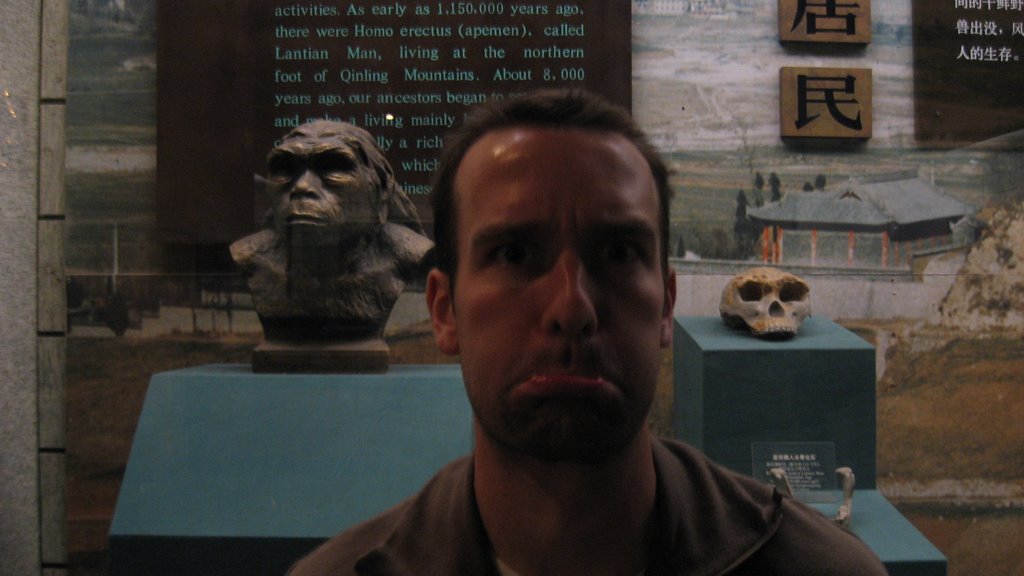
Xi’an left Seabass and me with some mixed feelings. Xi’an was no Shanghai, and it’s certainly fair to point out that Shanghai was no Xi’an. Basically, we went to Xi’an because it's very old and had a hell of a heyday, on the scale of Cairo, Egypt or Rome, Italy.
In fact, the city sits in an area considered by many the other cradle of civilization, the one in the Middle East being far from civilized as of late. In other words, the area of Xi’an was one of the first places in the world to have humans cover their dongxi (that’s Chinese for your thingy) and produce food, writing and art.
While it’s tough to critique Xi’an when it comes to significance within the course of human events, regretfully, the same can’t be said for those wishing to have drunken blast here. There are bars and clubs to socialize in and have a good time, but they are too contrived and leave little to creativity, which is what gimmicky bastards like us are all about. The establishments we saw cost too much money, the women were likely on the clock and there were five-foot bouncers at every table eager to glare your fun away. Obviously, we could have overlooked the best bar in the world, but I have my doubts.
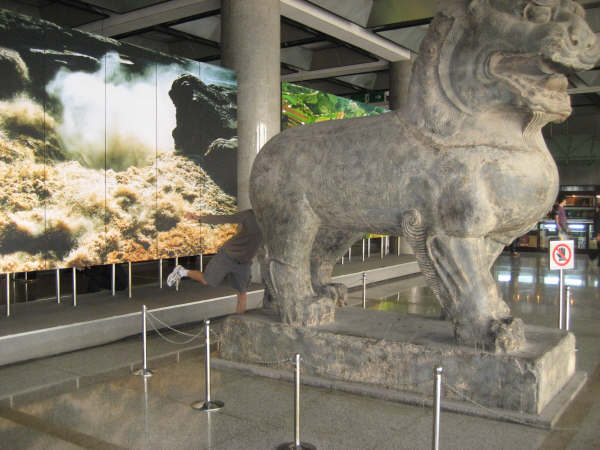
I say this to warn those hoping to find paragraphs dedicated to drunken madness. If that’s the only thing you are looking for, stop reading, or perhaps reread Seabass’s Shanghai story because it’s so good. In Xi’an, we got drunk and had some fun, but it wasn’t up to standard. Instead, we got an unavoidable history lesson. If you want to learn a bit about our trip and how old this place is, read on…

—The hole-tel
Before I get into what we did, I want to point out that our first night in Xi’an went badly. Our hotel offered all the amenities to make a hotel disturbing and uncomfortable. When we first walked in, things seemed passable. The counters and lounge were clean, a bit outdated, but not unkempt. The one hint of the hotel being a lesser establishment was the fact that 40-something men were sleeping on the lounge couches, some with their feet higher than their heads and cigarettes dangling out of their mouths. Yet, we shrugged this off and checked in.
On the way to our room, the halls were leak-stained, gloomy and smoky. In fact, a thick smoke sat throughout the city. The smoke turned brilliant reds and yellows into black and white and gray. Apparently, it was due to dead, immovable air and the fact that the region’s farmers burn their leftover crops during the fall. Yet, while we had an explanation for the unhealthy haze, it was strange to see the smoke indoors. In the states, smoke alarms would have been blaring. This hotel didn’t have any so there was nothing to worry about.
The smoke became the least of our concerns, however, once we stepped inside our room. When we opened the door, a horrendous stench wafted into the hall. It smelled like industrial strength cat piss. The odor brought tears to our eyes. I, amazingly, was about to accept the stench. I think because I was afraid to walk back through the long, eerily smoky hallways.
Seabass trumped my fear though with one simple, “Let’s get the hell out of here.”
The front desk gave us a new room, this time with red-stained sheets. Optimistically, I assumed this was rust. Then, there was the bathroom that we were afraid to enter…and the carpet that was dry yet felt wet if you stepped on it barefoot (I found this inexplicable and kept trying to prove it was wet, but never succeeded)…and outside our window, some machine, something along the lines of an antique HEMI engine, that rattled noisily around the clock. But, at least we could breath.
—Outnumbered
Seabass and I eagerly left the hotel first thing in the morning and caught a bus to the Terracotta Warriors. Both books and people told us we should visit the archeological site. There, Qin Shi Huang, the first emperor of the Qin dynasty, apparently wouldn’t be caught dead without an army. So he had more than 8,000 mud-baked warriors, horses and chariots buried with him. The site is over two thousand years old.

Well, it turned out China had the same trip in mind as us, which made sense because we were traveling during a Chinese national holiday. Every family and their allotted kid decided to visit the Terracotta Warriors for their vacation. This was not a problem for us, we love our fellow man, but the terracotta army stood no chance against such an army of tourists.
The only thing that maybe prevented a complete route of the terracotta army was the third great force at the museum: the vendors. The vendors numbered in the hundreds.
As you approach the archeological site, the path includes city blocks of vacant, new brick buildings with no sign of ever being put to use. The vendors stood outside of these buildings, each one selling the exact same shoddy wares. They hounded us with hellos and “buy, buy, buy.” Someday, I imagine, these country folk will be pushed away by middle-class vendors investing in the new storefronts. Then, the middle-class vendors will sell the exact same things, block after block after block, just like the poor vendors do today.
When we finally arrived at the museum, sure enough, the life-size soldiers stood frozen in rows, impressing the world with their eternal immobility. I was as impressed as the next guy. However, the structure that housed the site was notable too. The day-lit warehouse easily outstretched the length of two football fields to protect the terracotta soldiers, as well as the endless stream of Chinese tourists.
—The rest of the Xi’an affair
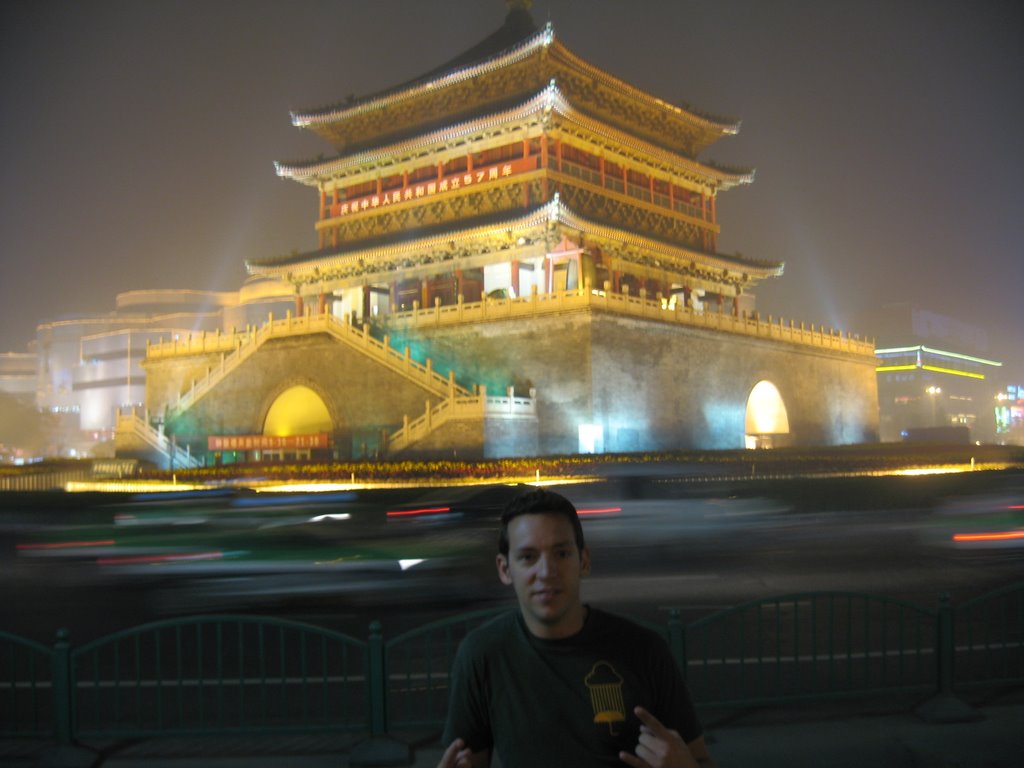
Suffice it say, the next day Seabass and I abandoned the miserable slum and upgraded to a place within the city center. We explored the city with more ease and, during the evenings, drank in the town square between two impressive poly-dynastic structures, one called the Bell Tower and the other the Drum Tower.
Also, we befriended a Chinese couple named Xin and Sam. Sam, we would later learn, is a great dancer. An accountant, he wears skin tight turtlenecks and peach t-shirts. Watching him dance in a club is a site worth coming to China for in itself. He flops and flips around like Pinocchio under the strings of Geppetto. Xin joined Sam for a vacation in Xi’an, I think to see if he was worth a long term relationship. I hope it works out for them.
At one point we four rented bikes and rode around the walls of Xi’an. The walls, built during the early Ming dynasty, are about 50 feet high and 60 feet wide. The structure is about 9 miles around. For a few bucks you can give yourself an ass-massage, bumping over the bricks that make the 1400 year-old wall. This experience was definitely worth every yuan.

On a different day, Seabass developed a very close relationship with our toilet because he ate (we think) rotten dog that he bought on the street. I decided to leave Seabass at the hotel so Sam and I could head for a famous mountain a couple hours outside Xi’an called Hua Shan. Hua Shan is a sacred Chinese mountain with a reputation for being both a breathtaking and somewhat dangerous climb. Sam couldn’t do it, but I managed to convince a phobic, and perhaps lazy, Xin to make an attempt for Hua Shan too. We embarked for the mountain before dawn.
When you travel in China to tourist sites, there are two methods: the hard to find and difficult to use city and provincial buses; and the private buses that can’t wait to pull you inside their vehicle and prey on your foreigner vulnerabilities. I try my damnedest to avoid the latter, but Sam and Xin climbed onto one of these sharks because the legitimate way was too much trouble to figure out.
For a little less than five bucks we caught a ride to the town below the base of Hua Shan. Then we paid another 10 bucks for a tram up the first half of the mountain, and another couple bucks for a ride to the base of the mountain. This is typical in China, no one thing is expensive, but you get nickel and dimed until you end up spending a day’s paycheck.
 The ride up the gondola was awesome. Hua Shan surprised me with its ruggedness and height, especially since the area around Xi’an is flat. The granite cliffs are a few thousand feet high and cut sharply to the base of the mountain. The gondola takes you up to the North Peak, the lowest of the five peaks. From there we hiked up toward the West Peak using an iron chain which serves as a guide. Looking up the mountain from the North Peak, the trail stretched almost vertically to the higher West Peak. On the path, thousands of Chinese pilgrims trudged toward the sky.
 No matter the height or difficulty of the path, the vendors, sure enough, were there to sell trinkets. Also, on Hua Shan, there are several Daoist temples as well as a couple hotels. The cost I think would be worth it if you had the time to stay because the mountain is so unusual and beautiful.

I don’t know any statistics, but I imagine more than a few Chinese took a step in the wrong direction during a photo op on Hua Shan. One spot actually made my throat dry from fear. On the East Peak, there exists a path that is no more than two feet wide. The mountain side brushes one shoulder and falls away a thousand feet from the other. At the end of the 150 foot path, a cave ensconces a Daoist shrine. There, before the shrine, a monk sat on a swinging chain that separated sky from mountain. He was relaxed and indifferent to the drastic nothingness below him. I tried to talk to him but failed. The only information I managed to gather was that I shouldn’t take a picture of the shrine.
By nightfall Xin, Sam and I returned to Xi’an. Seabass recovered from his illness and we all went out to drink beer in the streets. Seabass brought his guitar and played for some crowds and even befriended a 15 year-old boy that probably hadn’t seen a bath in weeks, or longer. Seabass gave him a sticker of his band Cast of Characters and sang for him. He wouldn't accept anything else. What he did take, he seemed overjoyed with, and I think was conscious of meeting a person who acknowledged him with sincerity.
Later on, Seabass and I were drunk, I didn’t have the camera securely held, and he accidentally kicked it from my hand when I was about to take a picture of his funny pose. The camera broke and we were both bummed. That more or less concluded our time in Xi’an. Again, it was no Shanghai, but then again, Shanghai is no Xi’an. Now, we need to get his camera fixed. Peace.

Subscribe to:
Posts (Atom)
